

VAT Compliance Solutions | Guide to Dutch VAT and Fiscal Representation
Empowering cross-border businesses to operate compliantly in the Netherlands, optimize VAT cash flow, and grow across the EU.
Our VAT Services
Act as a Dutch general fiscal representative (GFR)
Act as a Dutch limited fiscal representative (LFR)
Apply for a Dutch Article 23 import VAT deferment license
Apply for a Dutch VAT warehouse license
Register for a Dutch EORI number
Register for a Dutch VAT number
File VAT declarations
Review and advise on VAT compliance

Get to Know Dutch VAT
Dutch VAT Number
Importing goods into or through the Netherlands, holding stock in a Dutch warehouse, or making taxable supplies there creates Dutch VAT obligations for a non-Dutch-established company. To account for and report Dutch VAT, a non-Dutch company has two options: register for its own non-resident Dutch VAT number, or appoint a Dutch-based limited fiscal representative (LFR) and use the representative's LFR VAT number.
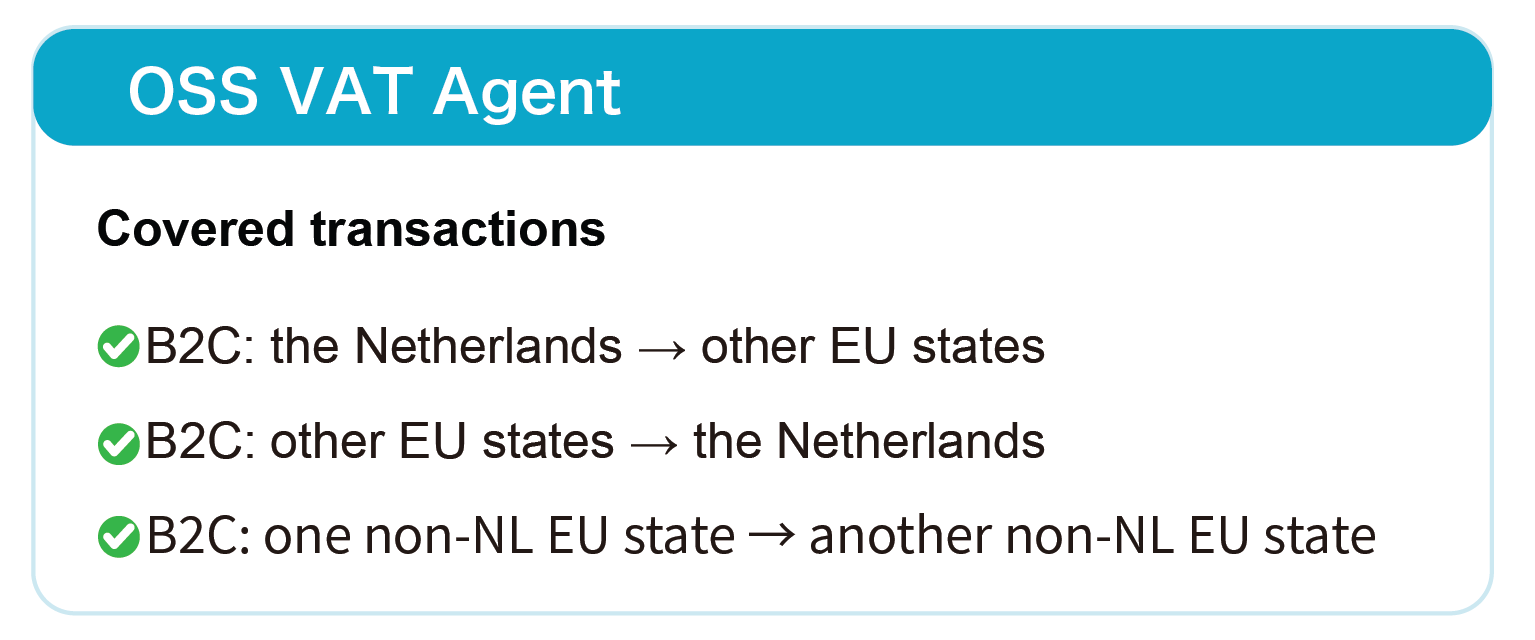
However, if a business sells to consumers (B2C) within the EU through its own website and chooses the Netherlands as its OSS member state of identification, a LFR cannot be used. The business must first register for its own Dutch VAT number.
Dutch VAT Filings
Businesses fulfil their obligation to account for and report Dutch VAT by filing VAT returns and, where applicable, EC Sales Listings and statistical (Intrastat) declarations.
A Dutch VAT return is a periodic tax declaration that businesses are obligated to submit to the Dutch Tax Authorities (Belastingdienst), in which a business reports all taxable transactions conducted during a given period.
An EC Sales Listing is a report that businesses are obligated to submit to the Dutch Tax Authorities whenever intra-Community supplies are made within the relevant reporting period, declaring all zero-rated supplies made to VAT-registered customers in other EU member states. It enables Tax Authorities across the EU to cross-check and verify intra-Community transactions, ensuring VAT compliance and preventing tax fraud.
Intrastat is a statistical reporting system used across the EU to collect data on the movement of goods between EU member states. The declarations capture detailed information on the value, volume, and nature of intra-Community trade, and are used by EU institutions and national governments for economic and trade analysis purposes. In the Netherlands, companies may become subject to an Intrastat reporting obligation if they are selected by Statistics Netherlands (Centraal Bureau voor de Statistiek, CBS) as part of a statistical sample for intra-Community dispatches and/or arrivals. Upon receiving a formal notice from CBS, the business must submit periodic Intrastat declarations.
Dutch Fiscal Representative
A foreign business may appoint a Dutch tax services company as its fiscal representative to handle its VAT administration and compliance obligations in the Netherlands. In certain circumstances, appointing a fiscal representative is a legal requirement, for example when a foreign business applies for an Article 23 import VAT deferment license or a VAT warehouse license.
The fiscal representative acts on behalf of the foreign business in Dutch VAT matters and is jointly and severally liable for the VAT due on the business's taxable transactions in the Netherlands. Its responsibilities include periodically reviewing the VAT-related data and documentation maintained by the foreign business for compliance, filing VAT returns and EC Sales Listings on the business's behalf, and, where applicable, submitting Intrastat declarations to Statistics Netherlands (CBS).
A general fiscal representative (GFR) represents the business for all supplies of goods and services on which Dutch VAT is due. The business must itself be registered with the Dutch Tax Authorities, and the GFR files VAT returns on its behalf under the business's own Dutch VAT number.
A limited fiscal representative (LFR) represents the business only for a restricted set of transactions, mainly the import of goods from non-EU countries and their subsequent sale. The business does not need to register for Dutch VAT itself, but instead uses the LFR’s VAT number. The LFR files VAT returns under its own VAT number for all of its clients.
Please refer to the comparison chart below on this page for more details.
Article 23 Import VAT Deferment license
The Article 23 import VAT deferment license is a key benefit of fiscal representation in the Netherlands. It allows import VAT to be accounted for in the VAT return rather than paid at the point of import, giving businesses a significant cash flow advantage.
VAT Warehouse License
A VAT warehouse (btw-entrepot) is a Dutch VAT arrangement that lets goods be stored and traded in the Netherlands without VAT being charged while they remain in the warehouse. VAT only becomes due when the goods leave the warehouse for a taxable supply or for use in the Netherlands. There are two types: a location-bound VAT warehouse, which is a specific, licensed storage site, and a non-location-bound VAT warehouse, which is a license held by the buyer. To apply the 0% rate to supplies into a VAT warehouse, the supplier must meet certain administrative conditions, such as obtaining a written declaration from the buyer that includes the warehouse license number. A business that is not established in the Netherlands must also appoint a fiscal representative.
B2C — One Stop Shop (OSS)
OSS (One Stop Shop) is an Intra-Community B2C VAT simplification scheme that allows businesses to register for OSS in a single EU member state and report all cross-border B2C sales across the EU through a single quarterly OSS VAT return. Rather than registering for VAT separately in each EU member state where sales are made, businesses can manage all their Intra-Community B2C VAT obligations through one central registration.

General Fiscal Representative (GFR) & Limited Fiscal Representative (LFR)

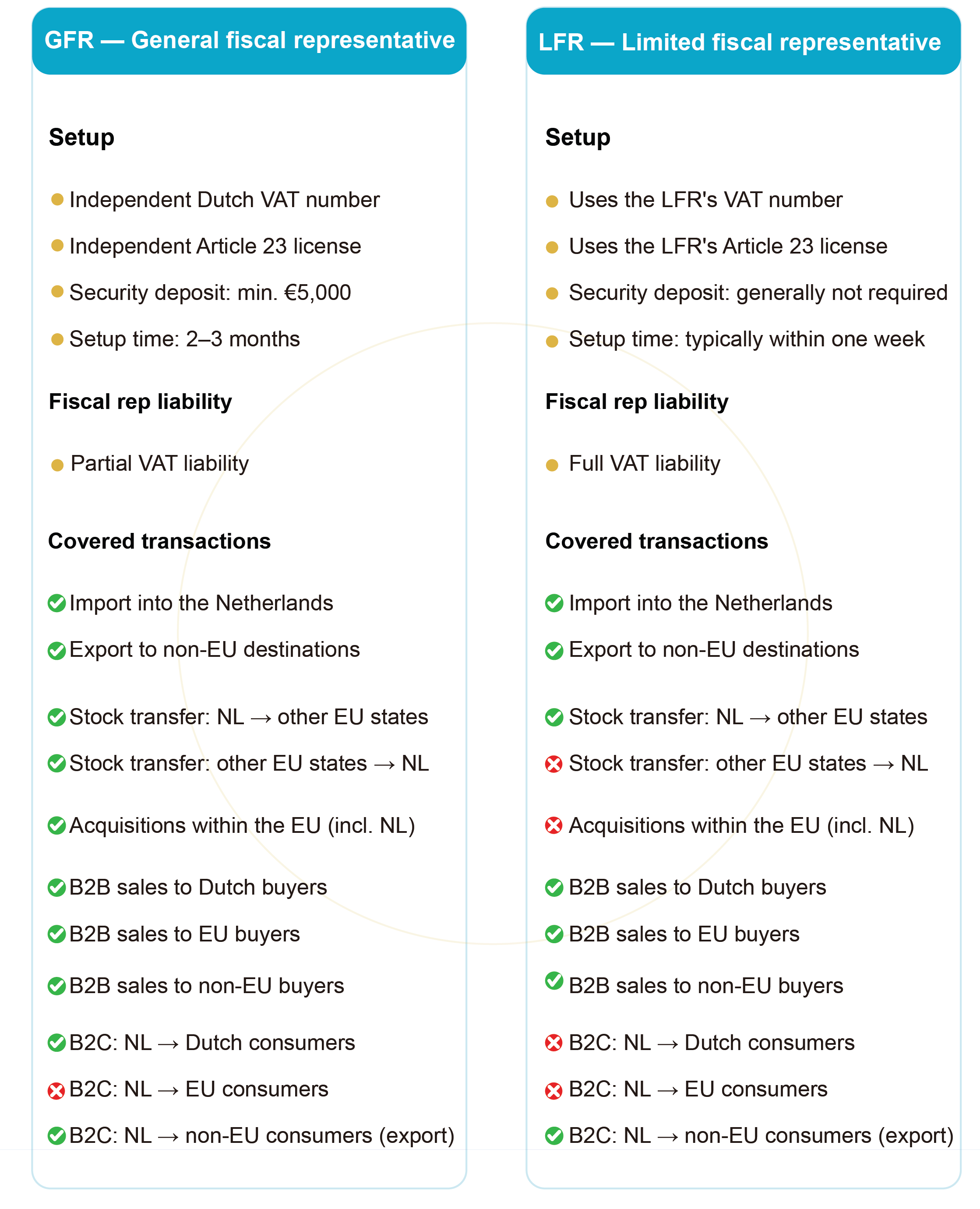
Note: 1) All entries above are based on goods supply scenarios. 2) LFR coverage reflects both Dutch VAT regulations and Augmar's internal business policy. 3) The listed transactions represent primary routine taxable activities and do not constitute an exhaustive list.

Want to know more?
Contact us today — we'll craft a compliant tax solution tailored to your business.
Free initial consultation